Lava flow at Piton de la Fournaise forms ocean entry – eruption intensified
The eruptive activity of Piton de la Fournaise since 13 February 2026 is part of a current reactivation phase of the volcano, which had already been preceded by increasing seismicity and ground inflation at the end of 2025: after the lava crossed the coastal road on 16 March, it has been flowing into the ocean since 18 March, where a lava delta is growing. It has now reached a volume of 200,000 cubic meters and measures 130 × 665 meters. During the night of 20 March, the eruption intensified, and a lava fountain is once again being emitted from the active vent at the base of the summit crater cone.
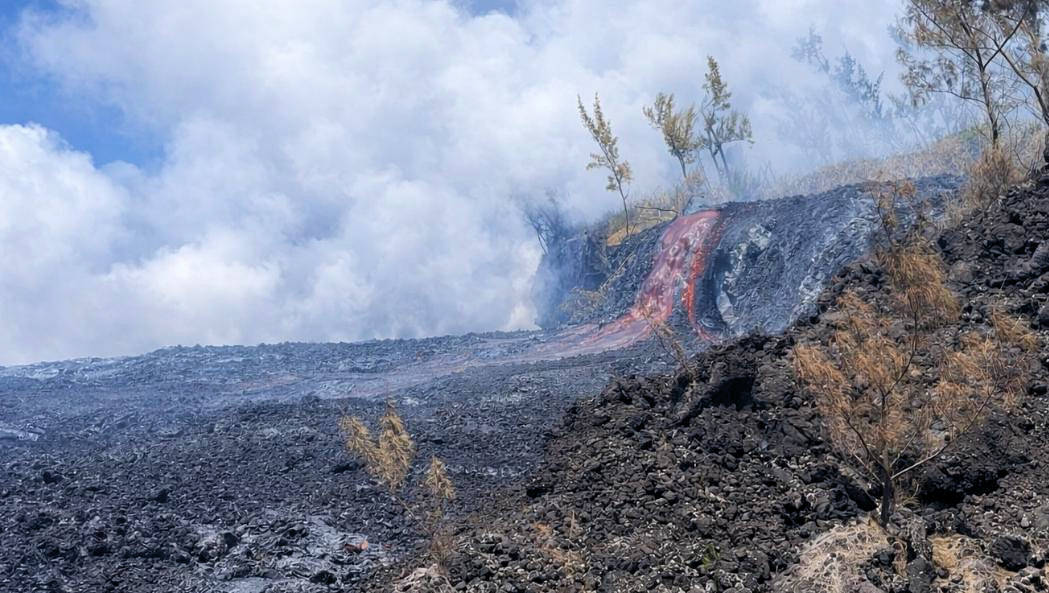 On 13 February 2026, a new effusive eruption began at Piton Fournaise, considered the second eruption of the year and occurring only a few weeks after an event on 18 January. It was characterized by the opening of one or more eruptive fissures within the Enclos Fouqué caldera, from which basaltic lava fountains and lava flows emerged. Shortly after the onset, an extensive sulfur dioxide plume was detected, spreading over more than 500 km, indicating intense gas emissions.
During the first days, the activity was concentrated in a main vent area where a scoria cone formed. Lava fountains reached heights of about 15 meters, while the lava flows were well channelized and covered older structures. At the same time, structural changes occurred, including the collapse of a previously formed cone, highlighting the dynamic nature of the eruptive center.
As the eruption progressed, the effusive activity continued. Lava flows moved downslope toward the coastal plains (“Grand Brûlé”) and eventually reached infrastructural areas. Particularly noteworthy is that the lava reached the ocean again for the first time in around two decades. This led to typical interactions between lava and seawater, including steam explosions and the formation of volcanic glass as well as so-called “laze” (acidic steam).